

This publication may prove a useful addition to your compressed air information file. If you would like more information on a particular topic, let us know and we will do our best to help you
Table of Contents
ToggleCONTAMINATING YOUR COMPRESSED AIR MAINS?
The quantity of water that can be contained in air is dependent upon the volume and the temperature. The greater the volume and the higher the temperature, the greater the quantity of water vapour contained. When air is compressed to a higher pressure the air volume is decreased.
As an example, if air enters a compressor at 50% humidity at 20° C, the air contains half the quantity of water that it could contain at that particular condition. If the air is compressed to 10 bar gauge (150 psi) the volume is reduced to one tenth, therefore under the same conditions of temperature, most of the water vapour, in fact 80%, must condense out, for the simple reason that there is not enough space to contain it. From this explanation, it will be understood that air leaving a compressor is always saturated. Equipment must be installed to remove the water oils and solids introduced by your air compressor.
HOW TO REMOVE CONTAMINATION FROM YOUR COMPRESSED AIR
There are four methods to clean the compressed air:
- Air cooled or water cooled aftercoolers cool the compressed air. This creates precipitation (condensate) which can be trapped & removed from the air system.
- Drying the air using a chemical adsorption dryer.
- Drying the air using a refrigeration type dryer.
- Correctly airline installation & design.

Water in vapour form is sucked into the compressor from the atmosphere. The discharge temperature from a typical compressor is around 100°C. The air or water cooled aftercooler within the air compressor canopy reduces the air temperature to +/- 10°C above ambient air temperature or cooling water temperature (used to cool the compressor), and condenses the water vapour into a liquid that can be drained to waste by a reliable auto drain trap.
Either a refrigeration air dryer will condense, or an adsorption dryer will adsorb more liquids out of the air stream, giving the plant clean and dryer compressed air.
DEFINING DEW POINT
Confusion is often found over the definition of dewpoint and what the term dewpoint really means. This is a simple definition:
Pressure Dewpoint is the temperature at which water vapour in compressed air (or a gas) condenses from a vapour (gas) into a liquid, at a stated pressure. Dew Point changes with pressure, for example:
Compressed air with a dewpoint of +3°C at 7 bar Gauge = (minus) -23°C at atmospheric pressure.
If we state that the compressed air is dry to a dew point of 3° C at 7 bar, it means that the compressed air has been subjected to a physical temperature of 3°C and at this temperature the water vapour has turned into a condensate and has been drained out of the air flow by reliable automatic drains.
So, to get any more water out of this air, the compressed air, or the pipeline, or factory would have to be subjected to a temperature of lower than 3°C, but above zero degrees centigrade, because at zero the water turns to ice!
In the case of a twin tower heatless adsorption air dryer, a twin tower dryer adsorbs water from the compressed air in one vessel, while simultaneously desorbing (de-watering) the drying media in the second vessel. The drying media used can be activated alumina, silica gel or molecular sieve, dependent on the application.
The media within the online pressure vessel adsorbs the water vapour from the compressed air stream and retains the water molecules for +/- 3 minutes at the working pressure. After this time the vessels are rotated, and the saturated vessel is purged to atmosphere and, using a portion of dried compressed air from the online vessel, purges the offline vessel to remove previously retained water to atmosphere through silencers. This purge air would be at -40°C dew point at a pressure of 7 bar, but when reduced to atmospheric pressure and introduced as desorption purge air stream in the offline vessel, it will be at a dew point of approximately -53° at atmospheric pressure
This ultra dry purge stream means that the water is carried to atmosphere via silencers and the vessel adsorption media is regenerated. There is no radical change in temperature on the vessel but the air entering your plant is at sub zero dew points courtesy of the adsorption media.
To get any remaining water molecules to condense from a vapour to a liquid the factory’s ambient temperature would have to drop below -40°C. See dewpoint conversion chart below.
DEW POINT & PIPELINE HUMIDITY
Some folk suggest that a pressure dew point of 12°C below the ambient site temperature is a dewpoint that a client can / should accept. Please read the literature that they provide, and look at the statements very carefully.
The publication is likely written for Europe and assumes:
That your primary concern is pipeline corrosion? That a refrigeration dryer can be safely operated at a 13°C dew point and that relative humidity remains constant all day & night!
The short answers to these issues are:
- Engineers call us in to get rid of the water and oil and airborne debris in the airline. They do not call us in to discuss the state of corrosion in the airline piping. Airborne debris is classified as dust from the client’s site, rust, carbon, and even pollens amongst many other things.
- Expensive damage can be inflicted on dryers that operate above dew points of +10°C
- Relative humidity is not constant at all and fluctuates constantly. This means that if a dryer is selected to operate at 10° C. When the night time temperature drops to below 10° C water vapour injected into the airline during the day will now condense the water vapour into condensate at night.
This chart above easily converts a pressure or atmospheric dewpoint to either pressure or atmospheric pressure.
e.g. A pressure dewpoint of +3° C at 7 bar = -23°C at atmospheric pressure.

Bear in mind that its not always an ambient temperature that will change the air’s temperature. A simple regulator, when changing the air’s pressure, will often change the temperature of the air and may well cause condensate to form.
WHERE TO PLACE AIR RECEIVERS
Where to place the receiver is based on experience & logic. Secondary “dry” receivers may be placed after the final filter, if required. Many years ago, when large piston type compressors were the only option, a receiver was required as a pressure sensing vessel to provide a clear pressure signal to “load & unload” the mechanical air governor valve on these compressors. The air governor valve passed a signal from the receiver to the compressors valve fork type un-loaders to mechanically offload the suction valves on the compressor.
In a modern rotary screw compressor these controls are more sophisticated and the need for a pressure vessel may have largely fallen away, dependent on the compressors control system. However, check with your compressor supplier if you may operate your compressor without an air receiver. The function of an air receiver has changed from a load-sensing device to a bulk contamination catcher!

We recommend that the receiver is placed before the filters & dryer. The motivation for this is:
- The compressor has a clear pressure signal – without the pressure drops that filters may impose.
- The pre-filter/s have the least amount of oil and solids to block up the filter element. This is because some of this contamination will have settled in the receiver. Therefore, the service life is improved & the cost of operating the filter/s is reduced.
- If the air compressors air – oil separator filter fails, the +/-50 litres of oil (qty of oil is machine size dependent) that is released by the compressor is hopefully captured by the receiver. The oil is not sent on a direct collision course with the pre-filters and dryer.
- If the oil collides with the pre-filter, it may collapse the filter element, if this happens, filter element debris may / will be swept into the air dryer inlet. To get this debris out of a dryer is not easy, and can take days. In some cases, the debris is never removed and the dryer suffers a permanent internal pressure drop.
When operating an adsorption (chemical) air dryer, a receiver should be placed before the filters and dryer. The reasons for this are:
- The compressor has a clear pressure signal, without the pressure drops that filters may impose
- Regular attention must be given to the auto drains on each filter these must work!
- The pre-filters see the least amount of oil and solids to block up the filter element. Therefore, the operating cost is reduced and service life extended.
- If the air – oil separator filter fails, the +/-50 litres (qty of oil is machine size dependent) of oil that is released by the compressor is hopefully retained by the receiver. The oil is not sent on a direct collision course with the pre-filters and dryer.
- If the oil collides with the pre-filter the filter will often collapse, if this happens then the filter’s debris is swept into the air dryers’ chemical bed with the oil. Once the adsorption media is contaminated it loses its capacity to adsorb the water vapour and therefore it has to be replaced. THIS IS AN EXPENSIVE EXERCISE
- We prefer to use timed auto condensate drains. These should drain for +/- 4 seconds, every 4 minutes. This is a typical time sequence – adjust as seasonally necessary.
- Secondary “dry” receivers can be placed after the final filter, if required.
AIR LINE DESIGN & AIR VELOCITY IN PIPELINES
The correct layout of your compressed airline is essential. A well-designed system will reduce the amount of contamination that gets delivered to your application. See below:
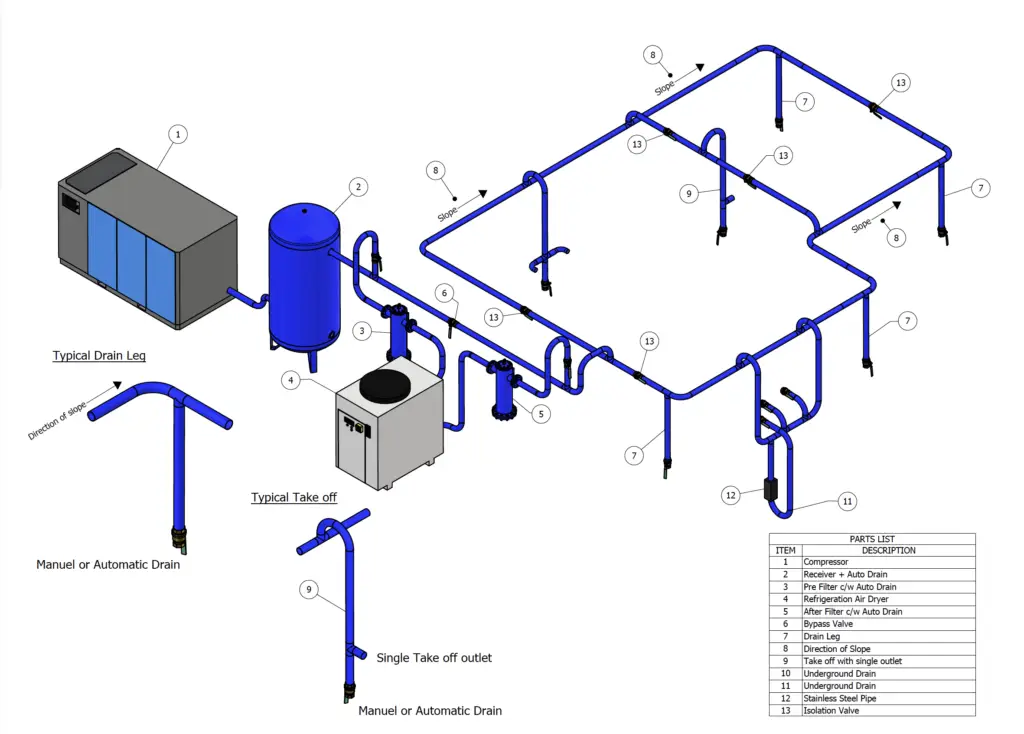
To reduce the amount of contamination, the bigger the pipeline, the slower the compressed air speeds in the pipeline, the lower the contamination levels delivered to your application.
If the compressed air velocity within the pipeline is high, the water, oils and airborne debris will get carried to the point of use and your line pressure drops increase.
If the velocities are lower, the contamination will drop out into the bottom of the pipe where it can be drained away to waste by the drain legs in the pipeline and pressure drops are reduced.
All airlines should have a perceptible slope in the direction of airflow. Most textbooks will tell us that the slope should have a gradient of 1:20. This is the “standard” but if a slope can be detected with the eye, then the slope is normally acceptable.
AIRLINE DESIGN – AIRLINE TAKE OFF’S
If the air take-off is from the bottom of the pipe, all the water inside the pipeline will automatically flow down into the application. If the air take-off is taken from the top of the main line, then the chances of water contamination at the point of use is greatly reduced, as the water oils and other “stuff” stays in the mains until it reaches a Drain Leg. At this drain point, the water will drop into a down leg where it can be drained automatically.
Type A and B take offs are just two of many types that can be used. Type A is a take-off for two points, while B is for one point. The air is taken to the point of use from the valve 600 mm above the bottom drain valve. Note the direction of airflow and the slope in the airline.

COMPRESSED AIR RING MAINS
Straight airlines that do not form a ring system will often have pressure drops at the end of the airline. A ring main, as shown below, allows air to flow from both directions to a take-off point. This minimises the pressure drops in the distribution system.
Please take note of the following important points:
- Direction of the pipe slope.
- The position of drain legs at the end of the main lines.
- The way a pipe bridge is installed.
- The design of the air take-offs.
- The installation of main line isolation valves to allow the mains to be added to, or be maintained in “normal” working hours.
If this system is implemented with no exceptions, the pipeline contamination is significantly reduced. When a dryer is installed, contamination is virtually eliminated.

UNDERGROUND AIR LINES
These lines, as a general rule, should be avoided, as the cooler floor structure will promote water vapour trapped in the compressed air to condense from a gas, into a liquid. This means you are allowing your airline to generate more water contamination for you. Have a good look at the method below for draining the under-floor level piping. If you are forced into this style of piping then follow the layouts shown.
HOW TO DRAIN UNDERGROUND AIR LINES
In brief, the line should still slope in the direction of flow. At the end of the line install a small vessel at least 3 times the diameter of the main line. The socket feeding the vessel should be at least the same diameter as the line to be drained.
The drain valve is positioned above ground and can either be a manual drain or a timed automatic drain. No drainage pit is required and the pipeline can be completely buried. Note the final drain above ground before the line runs to below ground level.
Do not put float type drains into sub surface drainage pits, the pit will (eventually) fill up with water. When this happens, and when the air compressors are off, the ground water in the pit will flow back into the pipeline! |

If you have a long factory floor, a slope of 1:20 could mean that the pipeline will end up crashing into the floor. To avoid this install a “Saw Tooth” pipe design as shown.
This will allow you to remove water at regular intervals, and keep the pipe at a specific height and out of the way of staff and fork lifts.

PIPE SIZING
For main air lines, use these pipe sizes as a guide (for 7 bar air only). In simple terms, if you exceed the air speeds shown below, the dirt in the airline will be pushed to the point of use. This will ensure you get dirt and liquids where you least want them! This table below gives a guide to how much air may be carried by a variety of pipe sizes.
Higher velocities = higher pressure drops = wasted energy.

Undersized, small pipes will guarantee that all pipeline contamination is swept to where you are using the air, so like some things in life, Bigger is Better … especially when it comes to pipe lines.
PIPE SUPPORTS
These are the “normal” support distances for the correct support of a pipeline.
If there is any doubt get a qualified engineer to check, it’s dangerous and embarrassing to have pipes fall down!

OILY WASTE WATER TREATMENT
Compressor oils make up only a small portion of the total condensate volume, but this content is highly destructive for waste water treatment plants, as well as the natural river and wetland systems.
If you are discharging your compressed air oily waste into a storm water drain you are in contravention of pollution laws, as well as killing off our precious wetlands. A 28 m³/min lubricated air compressor running 24/7/52 will release 68 L* of oil into the airlines and treatment equipment every year.
*Based on 5 ppm/m3 of oil after the air/oil separator and prior to the built-in aftercooler
The compressor oils are retained and removed by coalescing filters, receivers, air dryers and air distribution systems. This equipment will eject compressor oils to waste via drain traps. This waste must be treated and retained and properly disposed of. To operate a plant without this equipment would be reckless and anti-social and illegal.

The Sepura oily water separation system using patented Silexa® media removes the waste compressor oils from the bulk condensate waste water stream easily and efficiently. Call into our office for more details.

DISCHARGE OF AIR THROUGH AN ORIFICE

These figures can be used as a guide and show the air flow through different hole sizes. Figures are in cubic feet per minute at standard pressure of 14.7 psi absolute and at 70°F.
The above figures should be taken as an approximate guide to the flow through a sharp-edged orifice, for this purpose a discharge coefficient of 0.65 has been used. For a nozzle or orifice with a well-rounded entrance, a discharge coefficient of 0.97 may be more appropriate and a suitable correction should be made.
Author – Allen Cockfield 18 May 2026 © ARTIC DRIERS INTERNATIONAL PTY LTD
Leave a Reply